
Gold Coast vs Zug: Which one wins?
A follow up comparison for buyers choosing between Switzerland’s two most requested addresses, once tax stops being the deciding factor.
In Buying in Zug for the Tax Savings: What the Numbers Actually Show, we found that on tax alone, Zug and Zurich’s Gold Coast are closer than either reputation suggests. Küsnacht’s municipal multiplier of roughly 73 percent, far below the city of Zurich’s 119 percent, brings the effective wealth tax on the Gold Coast into a similar range to Zug itself. Which means for buyers deciding between the two, tax is rarely the number that settles it.
This piece picks up where that one left off. For a CHF 10 million budget, what does each region actually deliver in space, momentum, schools and liquidity, the factors that decide the comparison once the tax line is roughly a wash.
What CHF 10 Million Buys at Current Reference Price Levels
Both markets have a broad average and a luxury segment, and the two should not be blended into one number. Zug city, rather than the wider cantonal average that also folds in cheaper hill and inland communities, sits at roughly CHF 18,738 per square metre on current RealAdvisor data. That is close enough to Küsnacht’s own broad municipality average, roughly CHF 17,600 to 19,000 per square metre depending on delineation, that a general address in either is, in practice, a near match on price. Zug’s own lakefront community, Walchwil, often called the Riviera of Lake Zug, actually prices above both at roughly CHF 21,000 per square metre. At the luxury end of the market, Küsnacht averages roughly CHF 37,000 per square metre, according to UBS Luxury Property Focus 2026, the highest of the four reference points below.
Plot size, micro location, lake frontage, building age and architecture all move the final number well beyond what a square metre average can capture, so the figures below are reference points for orientation, not a substitute for a site specific valuation
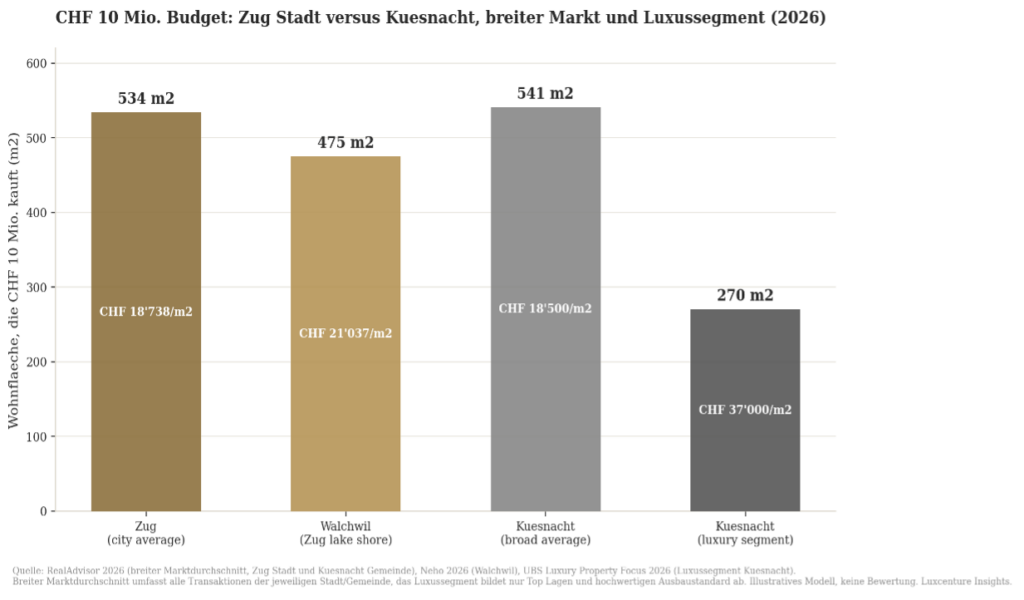
Living space for a flat CHF 10 million budget, broad market average versus luxury segment, 2026. Sources: RealAdvisor, Neho, UBS Luxury Property Focus 2026.
The detail worth sitting with is not Zug versus the Gold Coast, but the canton average versus the city. Zug’s wider cantonal figure of CHF 15,567 per square metre understates what a comparable, like for like address in Zug city itself actually costs, and once the comparison is run city to municipality, the broad market gap to Küsnacht nearly disappears. Only in Zug’s own Walchwil lake shore, and at the very top of the market, does a meaningful price difference reappear, and there it runs in Küsnacht’s favour.
Momentum, Not Just Price
Price today is only half the picture. Over the last ten years, Central Switzerland, the region that includes Zug, has appreciated at roughly 4.4 percent a year on average for single family homes, slightly ahead of the Zurich region’s roughly 4.0 percent, based on the Federal Statistical Office and IAZI hedonic price index discussed in our earlier piece. The difference is modest but persistent, and it has been running in Zug’s favour for over a decade, not just since the most recent cycle.
Zurich’s advantage lies elsewhere: depth and consistency. The Gold Coast has historically shown strong price resilience through different market cycles, while Zug saw its first recorded pullback among the regions UBS tracks in 2024, a reminder that faster average growth can still come with more volatility around the trend.
Zug vs Küsnacht Property Prices: Side by Side
| Zug | Gold Coast (Küsnacht) | |
| Broad market average | CHF 18,738 / sqm (Zug city) | CHF 17,600 to 19,000 / sqm |
| Luxury segment | CHF 25,000 to 40,000 / sqm | Approx. CHF 37,000 / sqm average |
| Effective wealth tax* | 0.5 to 2.5 per mille | 0.4 to 2.2 per mille |
| 10 year appreciation, houses | Roughly 4.4 percent a year | Roughly 4.0 percent a year |
| Drive time to Zurich Airport | Approximately 40 minutes | Approximately 20 minutes |
| Train time to Zurich Airport | Approximately 52 minutes | Approximately 26 minutes |
| International school on the doorstep | ISZL, Baar and Hünenberg campuses | ICS Zurich, Zumikon |
| Character* | International, entrepreneurial and relocation driven | Established, locally rooted and multigenerational |
* Indicative wealth tax ranges only, illustrated at roughly CHF 1 million net wealth in our earlier piece; the effective burden varies with taxable net wealth, property valuation, debt, municipality and individual circumstances. Character is Luxcenture’s own market observation, based on the buyers we work with in each location, not a statistically measured buyer census.
Where the Children Go to School
The Gold Coast’s defining advantage for international families is geographic rather than academic. Inter-Community School Zurich, the oldest international school in the region, founded in 1960, sits directly in Zumikon, inside the Gold Coast itself, offering the full International Baccalaureate continuum from early years through to diploma. A family buying in Küsnacht, Erlenbach or Herrliberg can put a young child on a school run measured in minutes.
Zug’s answer, the International School of Zug and Luzern, is equally well regarded and also IB throughout, but its two campuses sit in Baar and Hünenberg rather than in Zug’s lakefront communities themselves, which means a Walchwil address typically means a longer school run than a Küsnacht one does to ICS.
Getting to the Airport
For buyers who travel often, this is where the two addresses diverge most sharply. Küsnacht sits roughly 20 minutes from Zurich Airport by car and about 26 minutes by train. Zug is roughly twice as far, at approximately 40 minutes by car and 52 minutes by train, largely a function of routing around rather than through the city of Zurich. For a buyer who flies privately or commercially on a regular basis, that difference compounds over hundreds of trips a year in a way the square metre price never will.
Liquidity and Who Is Actually Buying
In our market experience, the two markets tend to draw different buyers, and that shapes how each behaves when it comes time to sell. Zug’s growth over the last two decades has been driven substantially by international, entrepreneurial and relocation driven wealth, drawn by the tax profile and the international community that has grown up around it. Demand has been strong, but it is a younger market with a shorter track record through a full cycle, illustrated by the 2024 pullback UBS recorded there.
The Gold Coast’s buyer base tends to be more established, locally rooted and multigenerational. Listings are scarcer, which supports price resilience but can also mean a longer marketing period when a specific property does come up. Neither pattern is better in the abstract, but they suit different holding periods and different tolerance for how a resale might play out.
Part of that buyer mix comes down to a rule most people overlook: lump sum taxation is still available in Zug, for qualifying foreign nationals who do not take up gainful employment in Switzerland, while the canton of Zurich, including the Gold Coast, abolished it years ago. For internationally mobile, non-working wealth specifically, that alone can steer the decision toward Zug before space, schools or the airport are even considered.
| Zug | Gold Coast (Zurich) | |
| Lump sum taxation (forfait fiscal) | Available, for qualifying non-working foreign nationals | Abolished, cantonal vote ended it years ago |
| Typical buyer profile* | International, entrepreneurial and relocation driven | Established, locally rooted and multigenerational |
| Resale turnover* | Comparatively higher, a younger market | Comparatively lower, scarcer listings |
* Luxcenture’s own market observation, not a statistically measured buyer census or turnover study.
| Gold Coast vs Zug: Which One Wins | |
| Choose Zug if | You value international community, entrepreneurial peers, slightly stronger long term appreciation, and are comfortable being part of a newer market |
| Choose the Gold Coast if | You prioritise proximity to the airport, established multigenerational neighbours, and one of Switzerland’s most established and supply constrained luxury residential markets |
| Choose neither on tax alone | The effective wealth tax gap between Zug and Küsnacht is narrow enough that it should rarely be the deciding factor |
Every figure above is a reference point, not a quote. At the CHF 10 million level, the actual comparison for any specific buyer comes down to what is genuinely available off market at the time, and the micro location within either Zug or the Gold Coast, factors a square metre average cannot capture. Our Search Mandate service exists specifically to test that comparison against what is actually on the market, not just what is listed.
Frequently Asked Questions
Is the Gold Coast more expensive than Zug?
At the luxury end, Küsnacht averages roughly CHF 37,000 per square metre against Zug’s luxury range of CHF 25,000 to 40,000, so the two overlap. On broad market averages, Zug city and Küsnacht are close enough to be a near match, and Zug’s own lakefront community, Walchwil, actually prices above both.
Which appreciates faster, Zug or the Gold Coast?
Over the last ten years, Central Switzerland, which includes Zug, has appreciated slightly faster on average, roughly 4.4 percent a year for houses against roughly 4.0 percent for the Zurich region. The Gold Coast has shown more consistency through the cycle.
How much closer is the Gold Coast to Zurich Airport?
Roughly twice as close. Küsnacht is about 20 minutes from the airport by car, Zug about 40 minutes, largely because Gold Coast routes run directly while Zug traffic routes around the city.
Does the tax difference between Zug and the Gold Coast matter in practice?
Less than reputation suggests. Küsnacht’s low municipal multiplier, roughly 73 percent against the city of Zurich’s 119 percent, brings its effective wealth tax close to Zug’s own range. For the full tax comparison across six Swiss regions, see our earlier piece, Buying in Zug for the Tax Savings.
Are property prices higher in Zug or Küsnacht?
On current broad market data, Zug city and Küsnacht are relatively close, at approximately CHF 18,700 per square metre in Zug versus roughly CHF 17,600 to CHF 19,000 in Küsnacht. In the luxury segment, however, Küsnacht averages around CHF 37,000 per square metre, while Zug luxury properties generally fall within a broader CHF 25,000 to CHF 40,000 range.