
Is Buying Property in Zug Worth It for the Tax Savings?
A data led look at Switzerland’s low tax cantons, twenty years of price history, and the alternatives few buyers price in.
Every year, a steady stream of buyers arrives in Zug with a single line of reasoning: the taxes are the lowest in Switzerland, so this is where the capital should go. It is not wrong. Zug has held the top spot in the country’s tax rankings for years. But it is incomplete. Two decades of price data, current tax statistics and the latest market reports tell a fuller story, one in which the saving buyers chase in Zug has already been partly priced into the property they are about to buy.
This piece walks through what the tax advantage is actually worth today, where the reasoning breaks down, and which alternatives, from Schwyz to Nidwalden to Geneva and Vaud’s lump sum regime, deserve a place in the conversation.
Why Zug Became the Default Answer
Zug combines the lowest overall tax burden in Switzerland with generous exemptions, a compact and international community, proximity to Zurich Airport, and some of the country’s most established international schools. For decades this combination has drawn entrepreneurs, executives and multinational headquarters alike, and it has made the canton the reflexive first answer whenever a client raises the topic of tax efficient relocation.
None of that has changed. What has changed is the price of admission.
The Number Buyers Rarely See
Since 2000, residential property prices across Switzerland have more than doubled. But the pace has not been even. The region that includes Zug, Schwyz, Nidwalden, Obwalden, Lucerne and Uri, referred to in national statistics as Central Switzerland or Innerschweiz, has appreciated almost as fast as the Zurich region itself, and considerably faster than the rest of the country.
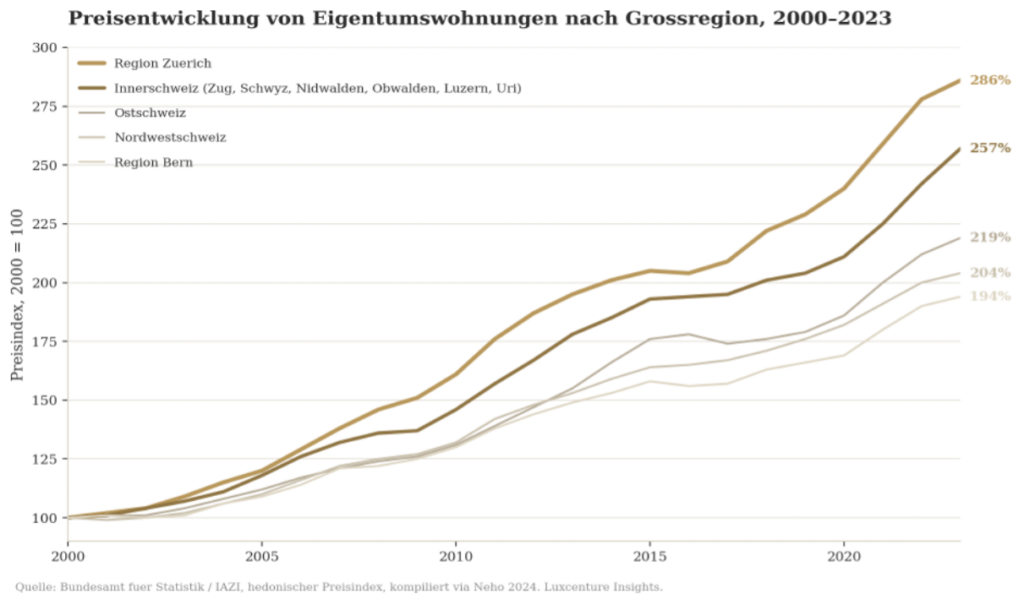
Price index for owner occupied apartments by region, 2000 to 2023 (2000 = 100). Source: Federal Statistical Office / IAZI hedonic price index, compiled via Neho, 2024.
In the luxury segment specifically, the picture sharpens further. Since 2019, prices for luxury property in Zug have risen by more than 40 percent. Square metre prices for high end apartments now sit between CHF 25,000 and CHF 40,000, and a villa in the canton averages roughly CHF 50 million according to UBS Luxury Property Focus 2026. For a 150 square metre apartment in a good location with a high standard of finish, buyers across Switzerland’s luxury communities should expect to pay between CHF 4 and 5 million, and family houses with more than 1,000 square metres of land frequently exceed CHF 10 million.
Yet in 2024, Zug was the only region among those tracked by UBS to record a price decline, a modest 2 percent pullback. Weaker employment growth and tightening mortgage affordability, even at the very top of the market, appear to be doing what tax competition from neighbouring cantons has not: capping how far Zug prices can run.
| The Arithmetic | |
Wealth tax at CHF 2 million, Zug | Approximately CHF 1,000 per year |
Wealth tax at CHF 2 million, Geneva | Approximately CHF 12,000 per year |
Zug luxury property appreciation since 2019 | More than 40 percent |
Effect on the wealth tax base | May increase as property values rise, depending on cantonal valuation methods |
Where the Logic Breaks Down
The comparison above is real, and it is the one most buyers see first. The comparison above is real, and it is the one most buyers see first. What it leaves out is that real estate forms part of the wealth tax base. As property values rise, the taxable value may also increase over time, although cantonal valuation methods mean this does not necessarily happen one for one with market appreciation. This can gradually narrow the gap between the low headline rate and the actual tax bill.
Add to that a materially higher entry price per square metre than in neighbouring cantons, and the payback period on the tax saving, the number of years it actually takes for the lower rate to offset the premium paid to get in, can stretch well beyond what most buyers assume when they first hear the word Zug.
The Alternatives Few Buyers Consider
Zug is not the only low tax canton in the country, and for buyers focused purely on the tax line, it is not always the cheapest one either.
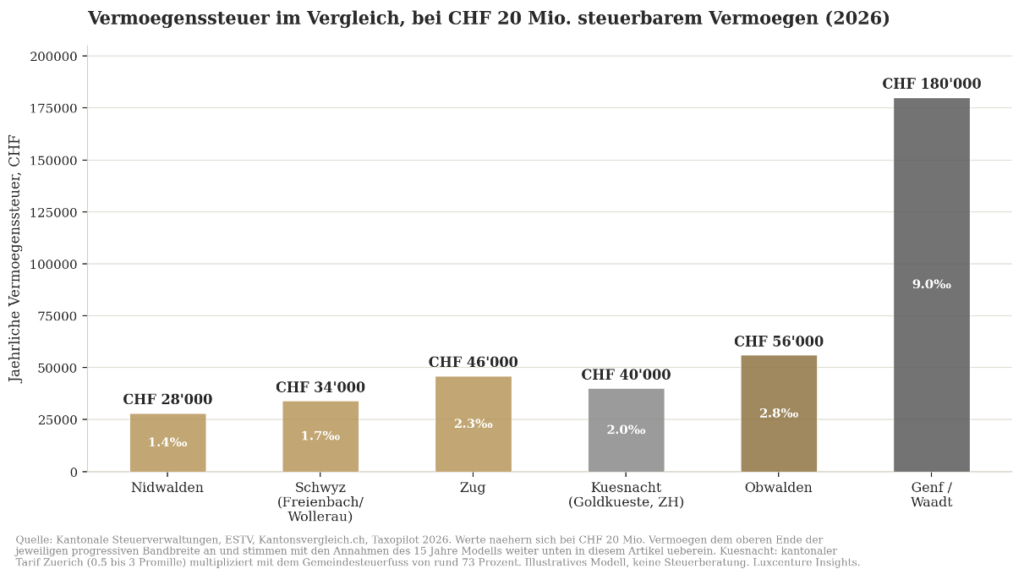
Effective annual wealth tax by canton at CHF 20 million net wealth, 2026, a level closer to what an outright buyer of an eight to ten million franc property is likely to hold, and the same basis used in the 15 year worked example later in this piece. Source: cantonal tax authorities, ESTV, Kantonsvergleich.ch, Taxopilot.
Schwyz, especially Freienbach and Wollerau
Above roughly CHF 150,000 of annual income, Schwyz overtakes Zug, and its lakeside communities of Freienbach, Wollerau and Feusisberg, part of the Bezirk Hoefe, sit on the left shore of Lake Zurich, colloquially known as the Silver Coast or, more recently, the Platinum Coast, in contrast to the Gold Coast on the opposite shore. They offer much of the same proximity to Lake Zurich and Zurich Airport that draws buyers to Zug in the first place, at a meaningfully gentler entry price, roughly CHF 15,000 to 20,000 per square metre against Zug’s luxury range of CHF 25,000 to 40,000, though that gap has been narrowing as demand spills over from Zug and the Gold Coast.
Nidwalden
Nidwalden posts the lowest effective wealth tax in Switzerland, sits on Lake Lucerne, and remains materially less expensive to buy into, with cantonal average prices around CHF 12,800 per square metre against Zug’s luxury range of CHF 25,000 to 40,000. It is quieter and less international than Zug, a trade off some buyers are glad to make and others are not.
Obwalden
Obwalden rounds out the group with similarly low taxation and the most affordable entry point of the four, at roughly CHF 9,950 per square metre on cantonal average. It has less of an international infrastructure than Zug or Schwyz, which matters more for some buyers than others.
Küsnacht, the Gold Coast benchmark
We include Küsnacht here for direct comparison, even though it sits in the canton of Zurich rather than Central Switzerland. Its municipal multiplier of roughly 73 percent is far below the city of Zurich’s 119 percent, which at higher wealth levels brings its effective wealth tax modestly below Zug’s own, despite the canton’s overall reputation as a high tax jurisdiction. What it does not bring is a lower price. More on the Gold Coast’s particular trade off follows below.
Canton | Effective wealth tax, CHF 20m wealth | Typical entry price / sqm | Character |
Zug | CHF 46,000 per year (2.3 per mille) | CHF 25,000 to 40,000 (luxury) | International, established, priced accordingly |
Schwyz (Freienbach / Wollerau) | CHF 34,000 per year (1.7 per mille) | CHF 15,000 to 20,000 (Silver Coast) | Lake Zurich, overtakes Zug above CHF 150k income |
Nidwalden | CHF 28,000 per year (1.4 per mille) | Roughly CHF 12,800 (cantonal average) | Lake Lucerne, quieter, most tax efficient |
Küsnacht (Gold Coast, ZH) | CHF 40,000 per year (2.0 per mille) | Roughly CHF 37,000 (luxury) | Zurich’s low tax lakeside enclave, priced accordingly |
Obwalden | CHF 56,000 per year (2.8 per mille) | Roughly CHF 9,950 (cantonal average) | Most affordable entry point |
The wealth tax figures above are shown at CHF 20 million of net wealth, a level more representative of a buyer able to purchase an eight to ten million franc property outright than the one million franc reference point often used for illustration, and they rise toward the top of each canton’s progressive band at that level. They are indicative, compiled from cantonal tax administrations and Swiss tax comparison services for 2026, and will vary with your own wealth, income mix and municipal multiplier. The square metre prices for Nidwalden and Obwalden reflect cantonal averages rather than a luxury only segment, since granular luxury data is not published for these smaller markets, while the Zug, Schwyz and Küsnacht figures draw on UBS Luxury Property Focus 2026. The Küsnacht wealth tax figure applies the canton of Zurich’s tariff of 0.5 to 3 per mille against Küsnacht’s own municipal multiplier of roughly 73 percent.
The Other Side of the Country: Geneva and Vaud’s Different Bet
Ordinary taxation in Geneva and Vaud sits among the highest in Switzerland. For a single person with CHF 100,000 of taxable income, the effective rate in Geneva runs to roughly 28 percent, against 15 to 18 percent in the cheapest cantons. Wealth tax follows the same pattern, in the range of 5 to 10 per mille rather than the sub 3 per mille bands of Central Switzerland.
What Geneva and Vaud do offer, alongside Zug, Schwyz, Nidwalden and most other cantons, is lump sum taxation, known as forfait fiscal, a regime with roots going back to Vaud in 1862 and Geneva in 1928. It is available to foreign nationals who are either moving to Switzerland for the first time or returning after at least ten years abroad, provided they do not take up gainful employment in the country. Tax is then assessed on the greater of worldwide living costs or seven times the annual rental value of Swiss housing, subject to cantonal minimums, rather than on worldwide income and wealth in the ordinary way. It is not unique to the high tax cantons at all. Zurich, Basel Stadt, Basel Landschaft, Schaffhausen and Appenzell Ausserrhoden are the notable exceptions, having abolished it at cantonal level by popular vote.
For qualifying buyers, this sidesteps the ordinary rate comparison entirely, and it is available in Zug just as it is in Geneva or Vaud. Where Geneva and Vaud stand out is in how the regime is applied in practice, generally with pragmatic administration and moderate minimum thresholds compared with some other cantons that also offer it. On the property side, UBS expects continued upward pressure on Lake Geneva prices in 2026, partly on demand from the Middle East, with Cologny already the most expensive lakefront location in Switzerland outside the Alpine resorts at roughly CHF 43,000 per square metre.
Zurich as the Reference Point
The canton of Zurich also abolished lump sum taxation years ago and carries no claim to being a low tax jurisdiction overall, with a municipal multiplier of roughly 119 percent in the city itself. But the canton is not uniform. Its own lakeside stretch, the Gold Coast running from Zollikon through Küsnacht, Erlenbach, Herrliberg and Meilen, keeps municipal multipliers far below the city, roughly 73 percent in Küsnacht and closer to 61 percent in Herrliberg, which puts the effective wealth tax on the Gold Coast within reach of Zug’s own range despite Zurich’s high headline reputation.
What the Gold Coast does not offer is a lower entry price. Küsnacht trades at roughly CHF 37,000 per square metre, among the highest in the country outside Geneva’s Cologny and the Alpine resorts, and the canton has just raised official property values for wealth tax purposes by 48 percent from 2026, the first such revaluation since 2009, which will lift tax bills even where the rate itself does not move. The canton anchors the strongest and steadiest twenty year price trajectory of any Swiss region, with apartment prices up 186 percent since 2000. For buyers who weigh liquidity, resale depth and long run appreciation as heavily as the annual tax line, that combination can be worth more than the delta to Zug, Schwyz or Nidwalden. It is a different calculation, not a wrong one.
What CHF 10 Million Actually Buys, Region by Region
Put every region discussed so far on the same footing and the erosion effect becomes concrete. The chart below assumes a flat CHF 10 million purchase budget and asks two questions for each region: how much living space does that buy, and what would the annual wealth tax on a property of that value look like.

Illustrative model. Living space for a flat CHF 10 million budget versus annual wealth tax on that value, by region, 2026. Wealth tax shown before the mortgage debt deduction most owners would apply, for comparability across regions. Sources: UBS Luxury Property Focus 2026, Neho, RealAdvisor, cantonal tax authorities, Kantonsvergleich.ch.
The pattern is the point. Between Obwalden and Nidwalden, the two lowest tax cantons in the comparison, the annual wealth tax bill on CHF 10 million differs by roughly CHF 11,000, yet the space that budget buys differs by more than 200 square metres. Between Nidwalden and Zug, the wealth tax gap is a modest CHF 6,000 a year, while the same CHF 10 million buys less than half the space. Even Zurich’s Gold Coast, with no reputation at all for low taxes, prices out at an effective wealth tax close to Zug’s own, while offering meaningfully less space per franc than either. The one region where the tax line genuinely dominates the comparison is Geneva, where both the tax bill and the price per square metre sit at the top of the scale at once.
None of this argues against Zug. It argues for running the two numbers side by side before choosing a canton on the strength of one of them alone.
A Better Way to Run the Numbers
Rather than choosing a canton on the headline tax rate alone, we encourage clients to work through four questions before committing: what is the actual annual tax saving in francs, not percentage points, at your specific level of wealth and income. What is the price premium per square metre relative to the closest comparable alternative. How many years of that saving does it take to absorb the premium. And separately from the arithmetic, how much do liquidity, school access, airport proximity and your own residency plans matter to you, because those factors do not show up on a tax table at all.
A Rule of Thumb | |
Step 1 | Calculate the annual tax saving in francs versus the nearest alternative canton |
Step 2 | Compare entry prices per square metre for a comparable property |
Step 3 | Divide the price premium by the annual saving |
Result | For an eight figure property, the payback period is often longer than buyers expect going in |
A Worked Example Over 15 Years
To make the framework concrete, we modelled a single buyer profile across the six regions discussed in this piece: a CHF 8 million property purchase, funded alongside CHF 12 million of other assets for CHF 20 million in total wealth, a net income of CHF 500’000 a year, income and wealth tax rates held constant throughout, and the property appreciating at each region’s own average rate over the last ten years.
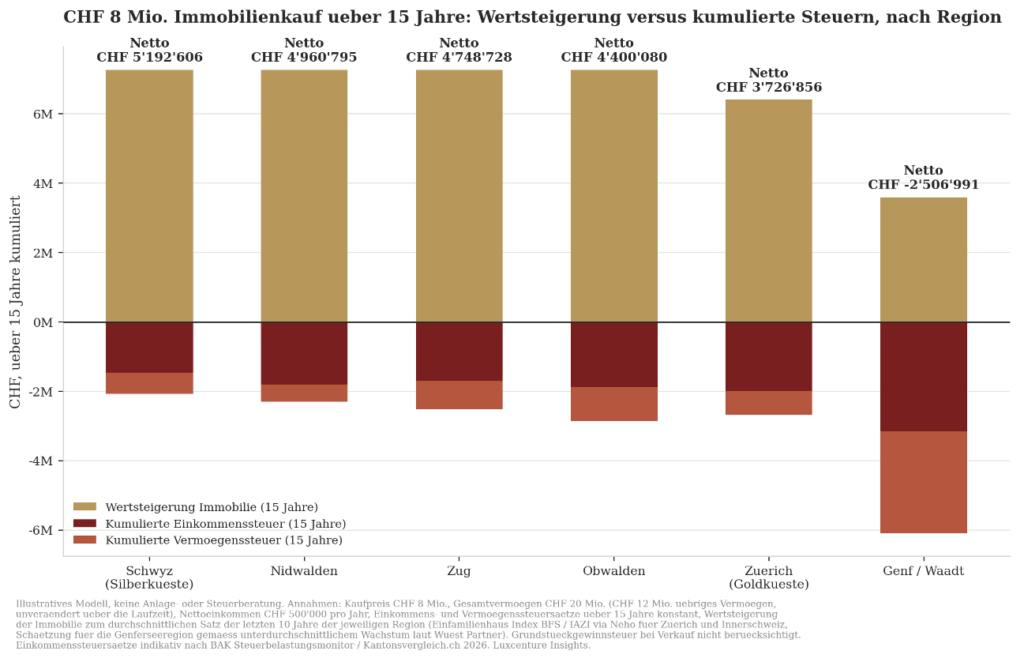
Illustrative model, not investment or tax advice. CHF 8 million property, CHF 20 million total wealth, CHF 500,000 net income a year, tax rates held constant over 15 years, appreciation at each region’s own 10 year average rate. Property gains tax on eventual sale not included. Sources: BFS / IAZI via Neho, BAK Steuerbelastungsmonitor, Kantonsvergleich.ch, Wuest Partner.
At this income level, wealth tax carries noticeably more weight in the outcome than it did in a higher earning scenario, though income tax still sets most of the ranking. Schwyz stays ahead of Nidwalden and Zug on the strength of its lower income tax, but Nidwalden’s exceptionally low wealth tax pulls it ahead of Zug here, a reversal from what a simple square metre comparison alone would suggest. Obwalden and Zurich’s Gold Coast trail the Central Switzerland cluster, Obwalden on a higher wealth tax band and Zurich on both a higher income tax and a slower ten year appreciation rate. Geneva and Vaud remain the outlier: even at half the income and with continued demand pressure on Lake Geneva prices, the combined income and wealth tax bill is large enough to turn the 15 year outcome negative, before any lump sum arrangement a qualifying buyer might use instead.
The exact ranking will move with your actual income, wealth mix and the property you are looking at, which is exactly why we build this calculation individually for clients rather than relying on the headline tax rate.
Frequently Asked Questions
Is Zug still the cheapest canton for taxes in 2026?
For most income and wealth levels, yes, Zug retains one of the lowest overall tax burdens in Switzerland. Above roughly CHF 150,000 of income, certain municipalities in Schwyz, notably Freienbach and Wollerau, can overtake it.
Does a rising property value increase my wealth tax even if the rate does not change?
Yes. Real estate is included in the wealth tax base at its cantonal taxable value. As property values rise, that taxable value may also be adjusted over time, although not necessarily in direct proportion to market appreciation.
What is lump sum taxation and can I qualify?
Lump sum taxation, or forfait fiscal, is available in most Swiss cantons, including Zug, Schwyz, Nidwalden, Geneva and Vaud, to foreign nationals moving to Switzerland for the first time, or returning after at least ten years abroad, who do not take up gainful employment in the country. Zurich, Basel Stadt, Basel Landschaft, Schaffhausen and Appenzell Ausserrhoden have abolished it. Tax is assessed on living costs rather than worldwide income, which can make it attractive regardless of a canton’s ordinary tax table.
Which canton has the lowest wealth tax in Switzerland?
Nidwalden generally posts the lowest effective wealth tax in the country, closely followed by Schwyz and Zug, all of which sit under 3 per mille for a one million franc fortune.
Should a property purchase be decided on tax grounds alone?
We would caution against it. Tax is one variable among several, alongside entry price, long run appreciation, liquidity and your own residency plans. A lower headline rate paired with a significantly higher purchase price can take years to pay for itself.
For a direct buyer focused comparison between Zug and Zurich’s Gold Coast, including property prices, schools, airport access and market dynamics, see our analysis: Lake Zurich Gold Coast vs Zug: The CHF 10 Million Question.